Top : Boat Design and Boatbuilding Books


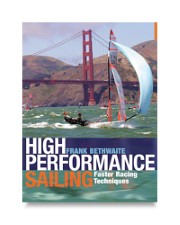
High Performance Sailing

In association with Amazon.com


 : High Performance Sailing

Price: $65.99
Prices subject to change.


Availability: Usually ships in 1-2 business days


Binding: Paperback
Dewey Decimal Number: 797
EAN: 9780070057999
Edition: 1
ISBN: 0070057990
Label: International Marine/Ragged Mountain Press
Manufacturer: International Marine/Ragged Mountain Press
Number Of Items: 1
Number Of Pages: 414
Publication Date: May 01, 1996
Publisher: International Marine/Ragged Mountain Press
Studio: International Marine/Ragged Mountain Press


Related Items: Alternate Versions: Click to Display

Browse for similar items by category: Click to Display


Editorial Review:

Book Description:
Based on 25 years of research and Olympic coaching, High Performance Sailing reinvents the strategies of sailboat racing. It presents revolutionary explanations of wind prediction and boat design, a fundamental rethinking of how to sail a boat fast--literally faster than the wind. Bethwaite's theories boosted the average speed of the highest-performance sailboats from two-thirds the windspeed to windspeed or faster. Bethwaite is Australia's most successful Olympic coach, and his family includes three Olympic sailing champions and three world champions. This book will have a revolutionary impact on racing sailboats and the way they are sailed.

"Essential for any serious racing sailor."--Gary Jobson

"It represents a breakthrough in the way that it relates the theoretical aspects of wind, seastate and rig shape to the way a crew would sail and handle a boat during a race. It has the potential to be a standard reference work on the subject and will not quickly date. It is a book that my Olympic squad will benefit from."--Rod Carr, British Olympic Sailing Team Manager

"Frank's book is a treasure chest, full of brilliant insights into the ways of air and water as they flow around our sailing boats. Best of all, he tells us what to do when we go sailing."--Alan Payne, Designer of America's Cup challengers Gretal I and II

"Allowed only one 'if only' in yacht racing . . . it would have been to have read Frank Bethwaite's High Performance Sailing years ago and to have it available for constant reference. Taking all the advice which he offers from his wide experience would have made championship winning a great deal easier."--Bob Fisher, Journalist, broadcaster and winner of many national and international sailing championships

"The most significant scientific thinking about sailboat racing to come along in three decades. A brilliant and important book for serious racing sailors."--Ed Adams, US Sailing Team Coach; national, North American, and world champion sailor

"Bethwaite's grasp of the entire spectrum of sailing speed is unique and formidable."--Gerry Hoyt, Yacht designer, sailing speed innovator


Customer Reviews
Average Rating:  out of 5 stars

Rating: 5 out of 5 stars - Overbearing in victory, surly in defeat
Just what is going on in a sailboat race (perhaps a regatta where everyone is sailing their 505 dinghies, and wearing t-shirts with comments on them such as the one in the title of my review)?

This book tells us plenty about what is going on.

The first part is about wind. And at once we're told about the various surface wind patterns, how they arise, and how often they repeat. The light air patterns are called "steady, unsteady, oscillating, and ribboning," while the breeze patterns are "steady, wandering, pulsing, convergent/divergent, channeling, and harsh." There's an enormous amount of specific advice about how to spot what is happening and how to react to each of these cases. We also see a discussion of the "stability index," which incorporates a number of factors that control predictability.

There's also some general race preparation advice. If your boat can match the speed of all the other boats in all conditions and you know what you are doing, that makes you the favorite, and you ought to sail conservatively. You pick three or four other boats that might win, ignore the others, and if those boats (roughly speaking) stay together, you stay in touch with them. "If you don't sail away from them, they cannot sail away from you." You beat them one by one by using the wind patterns, but only by enough to gain "the tactical advantage you need to be ahead of or inside of the selected boats at the next mark." Similarly, if you can't figure out a pattern, you can guess that a few others (perhaps with better "local knowledge") may know what they are doing better than you do. In that case, you should sail defensively, staying with the top boats. Those top boats will beat you, as will a few of the "gamblers," but you will beat most of the rest of the gamblers.

The second (and shortest) section is about water. That means a discussion of the types of waves, and the implications for proper boat handling, as well ... Read More


Rating: 5 out of 5 stars - This book is a MASTERPIECE written by a GENIUS !!!
I love this book, it is incredibly deep and detailed with excellent illustrations. Teaching sailing is my job and I study this to improve my own racing performance and I will be passing the gems from this book to my more advanced students.

It is very technical, which I think is a good thing, in that it gives you an understanding of a lot of the detailed science inherent in wind, currents, tuning, handling etc. Mind you, there is a lot of information here... so expect to spend a season reading it and digesting it all. Some of it is so complex I still don't quite grasp it... but I will return to it and work through it when I get time.

If one could somehow 'brain dump' all the information in this book into a medium-level sailor's mind... he would be well on track for an olympic campaign.

I love this book and it will always be on my shelf as a guide, reference work and an interesting read in its own right. I give it the highest possible recommendation and I would love to have the depth of knowlege, penetrating insight and breadth of intelligence to have written this masterpiece.


Rating: 5 out of 5 stars - how I got back into dinghy sailing
I was a hot shot dinghy sailor from the 1960's, read most of the books at the time. Reintroduced to this by my sons and the recent purchaser of a 29'er (Julian Bethwaite design) and as a somewhat hapless and occasional 50+ year old skipper of the same boat I decided to read up on the skills necessary for this skiff. Sometimes you are born too early. I could have used this information 30 years ago (but so could most of us if it had been known and available). Better late than never. The book covers slow (traditional keel, old style dinghys) boats, medium speed (high performance, laser 2's) boats and fast boats(skiffs). It is well written in a conversational tone. As in most scientific works you may need to reread some of the more analytical parts depending on your prior educational training. There are some interesting experiments that you can perform simply in your sink, bath tub, hot tub or pool to demonstrate the hydro/aero dynamic principles. I've got 30 or 40 sailing books in my library but this encompasses the most information on how to sail fast of the whole lot.


Rating: 5 out of 5 stars - The best book ever on sailing or building faster boats
I thought I knew about meteorology, waves, boatbuilding and sailing. I have a first class Cambridge degree in physics, have sailed and raced various boats (dinghies and sailboards) for 30 years and designed one fast dinghy. I thought I was one smart dude. Words begin to fail me. Wow! I wish I had known this lot 30 years ago. It turns out that I was pig ignorant. The book is the best I have ever seen on what the wind does. It's the best ever on how to handle it. It's extremely good on rigs and how to adjust them. It's not just the best ever, it's streets ahead. Don't expect to read it quickly. There is a vast amount to take in. If you really know your stuff you might get through it in a few weeks. Better to plan on a whole winter.


Rating: 4 out of 5 stars - Splendid reading for a sailing scientist
It's a great book, although I don't think it's something for the average sailer. A vast knowledge of science will help you understanding this book much better. The book is devided into four parts, of which I especially found the first two parts, named wind and water, very usefull. Wind is not just the story about high and low pressures, it's also translated to the effects you see on the water and the action that needs to be taken for maximum benefit. The water part is a good explanation about wave paterns and how to sail it. Parts three and four, called The Boat and Handeling, I found less usefull. It's better to buy a book who's specific on your type of yacht than reading a general story about this.


Boat Design.Net
Design Award


  Top Rated Sites
 
  Most Popular Sites
 
  What's New

  Boat Plans
 
  Books
 
  Designers
 
  Boatbuilders
 
  Materials
 
  Powerboats
 
  Catamarans
 
  Propulsion
 
  Sailboats
 
  Multihulls
 
  Software
 
  Resources
 
  Random Site
 
  My Links
 
  Gallery
 
  Forums
 
  Search

Thank You for Your Support of Boat Design.Net

Home  |  Top of Page